
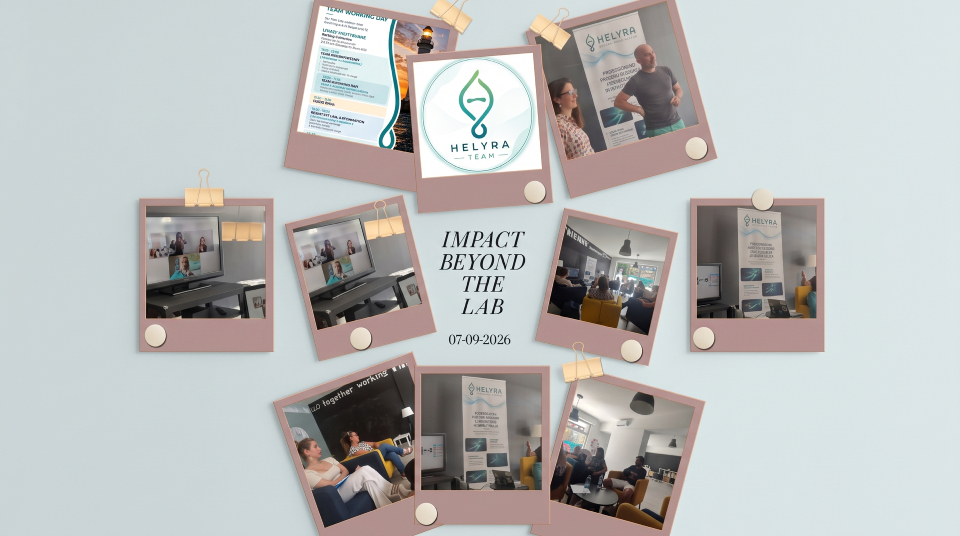
The first HELYRA Team Working Day took place in San Benedetto del Tronto, a day dedicated to aligning the team on ongoing projects, working methods and priorities for the coming months, alongside opportunities for discussion with researchers and external stakeholders.
We dedicated the first part of the day to internal team work: a structured coordination session bringing together the different areas of expertise within HELYRA, with the aim of sharing vision, methodology and priorities, and strengthening a common approach to research, innovation and scientific communication activities.
We discussed the projects we are working on, collaboration processes and our objectives for the next 90 days. It was an opportunity to bring together different areas of expertise and consolidate working methods capable of supporting research projects consistently, from defining activities to developing impact-oriented pathways.
During the morning, we also had the opportunity to meet with Prof. Claudio Ottoni, Associate Professor of Molecular Anthropology at the University of Rome Tor Vergata, for an in-depth discussion and dialogue between different scientific perspectives and areas of expertise.
In the second part of the day, we opened an invitation-only discussion focused on SEAWATCH, one of the projects we support, as part of the “Beyond the Lab | Conversations”. format.
The talk, “Sea Watch: From Research to Impact”, featured Prof. Tommaso Russo, Professor of Ecology at the University of Rome Tor Vergata and Principal Investigator of the project. The discussion allowed us to explore the scientific framework of SEAWATCH and its approach to monitoring marine biodiversity.
The project combines scientific observation with the direct involvement of fishing communities, valuing knowledge and experience developed in the field and fostering forms of collaboration between researchers and stakeholders directly connected to the environment being studied.
Together with the invited participants, we discussed monitoring methods, the relationship between research and local communities, and the role that participatory approaches can play in producing and sharing scientific knowledge.
For us, moments like these are an integral part of supporting research projects. We see scientific communication not only as the dissemination of results, but also as a tool for creating connections between disciplines, expertise, stakeholders and communities, facilitating an understanding of research and its relationship with the contexts in which it can generate impact.
The first Team Working Day therefore brought together two complementary dimensions of our work: on the one hand, internal coordination, which is essential for building a shared methodology and vision; on the other, the creation of spaces for discussion around projects, bringing research into dialogue with different perspectives and stakeholders.
It is within this space between research, collaboration and context that we want to work: supporting projects beyond the laboratory and helping to create the conditions for knowledge and innovation to translate into impact.
We would like to thank Prof. Claudio Ottoni, Prof. Tommaso Russo and everyone who participated and contributed to the discussion.


